
The Child Who Remembered the Sea
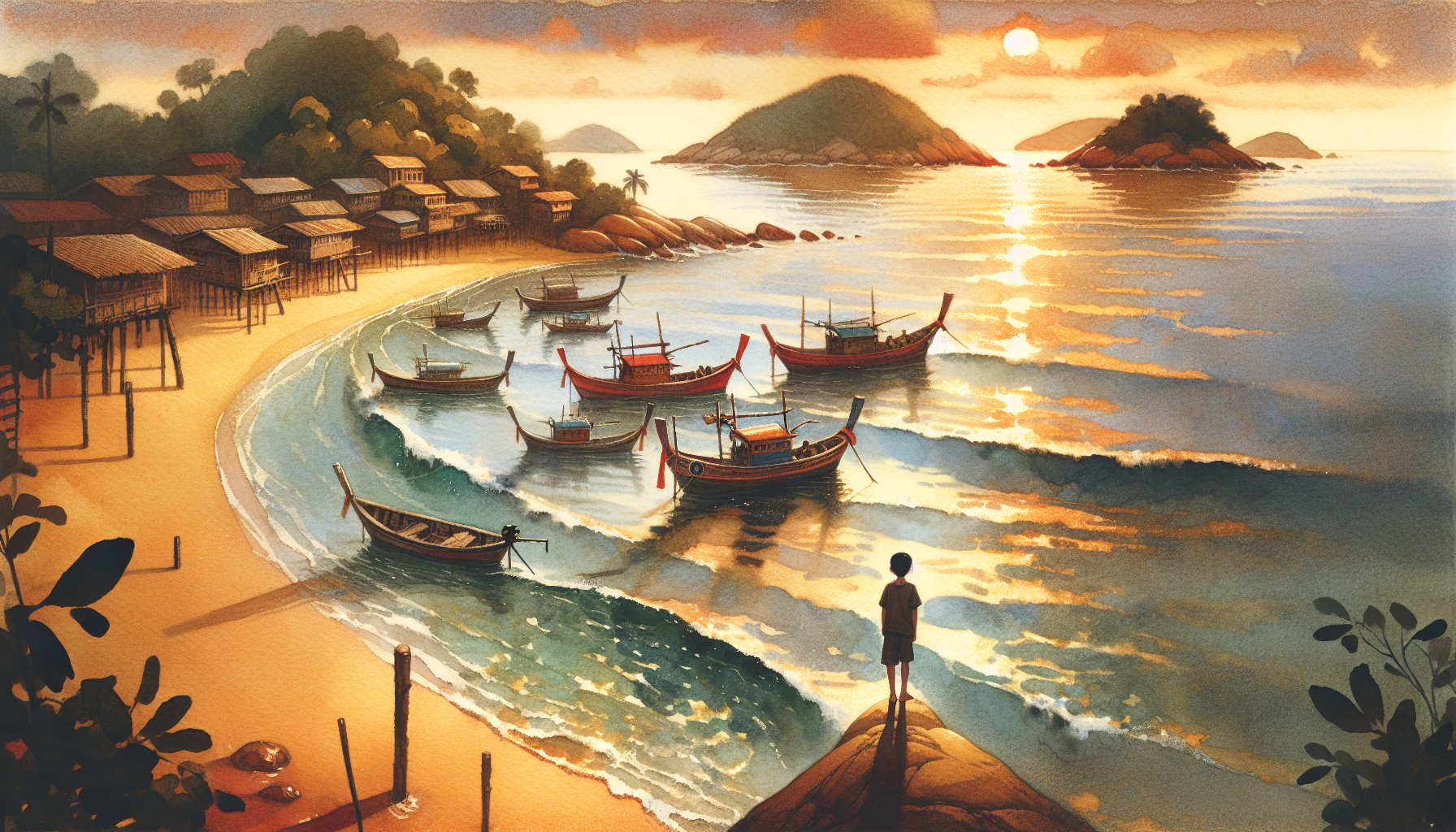
Once upon a time, on a finger of land that curled into the great ocean like a hand reaching for something it had lost, there stood a village of fishermen. Their boats were painted the colors of sunrise — red and amber and gold — and their nets were woven so finely that even moonlight could not pass through them without leaving a silver thread behind. The people of Coravel, for that was the village's name, loved the sea as one loves a grandmother: with gratitude, with a little fear, and with the deep certainty that she had always been there and always would be.
But one autumn, the forgetting began.
It started with small things. Old Benedito could not recall the name of the current that brought the mackerel in spring. Then the rope-maker forgot how to tie a sailor's knot her fingers had known since childhood. Then the harbor master woke one morning and stood at the water's edge frowning, as though the ocean were a stranger who had knocked at his door without invitation. Within a year, none of the villagers could say with any certainty whether they had ever loved the sea at all. They boarded up their boathouses. They turned their chairs away from the windows that faced the water. They planted hedges tall enough to block the smell of salt and brine.


But the forgetting did not stop there. That was the terrible thing no one spoke of, because no one could quite remember that there had ever been anything to speak of. The forgetting deepened the way a winter deepens — so gradually that you cannot say which morning was the morning the cold became something more than cold. Neighbors who had shared forty years of fish suppers and festival tables stopped meeting each other's eyes. Conversations grew shorter, then stopped altogether, like clocks winding down one by one. Children who had spent summers running barefoot along the harbor wall now stayed indoors and stared at nothing with expressions that made their parents uneasy, though their parents could no longer have said why. The village had always had color — red boats, amber lanterns, the golden windows of the tavern in the evening — but somehow, that autumn and the winter that followed it, the color began to leach away. The boats faded. The lanterns flickered and were not replaced. Even the flowers in the cottage gardens seemed to lose their conviction, drooping toward the earth as though they too were trying to remember something they could not name.
And the smell was wrong. That was what Mara noticed most, because she was the kind of child who noticed smells. The air over Coravel had always carried the sea in it — salt and iodine and the cold green breath of deep water. Now it smelled of dust and turned soil and something else, something she had no word for: the smell of a place that has forgotten it was ever loved.
Only one child still went to the shore.
Her name was Mara, and she was eight years old, with sand perpetually between her toes and hair that tangled in every wind. She had not forgotten because she carried inside her chest something small and luminous — a feeling, like a lamp left burning in an empty room — that told her the sea was not a stranger at all, but rather the oldest friend her village had ever known. She could not have explained it. When she tried, the adults looked through her as though she were a window with nothing interesting on the other side, and something about those empty, patient looks frightened her more than the dark or the cold or the strange new silence of the harbor.
She was very alone that autumn. Her mother had taken to sitting in the kitchen with her hands in her lap and her eyes on the wall. Her father spoke mostly in single words, as though language were something he had to ration. At school, her classmates had the glassy, incurious faces of children in a dream they could not wake from. Mara began to understand, slowly and with the particular dread of a child who grasps something that no adult has thought to protect her from, that if she did nothing, there would be nothing left worth saving.
One evening, she pressed her ear to the surface of the water and heard something that chilled her more than the cold.
The sea was quiet.
Not the peaceful quiet of a sleeping thing, but the hollow quiet of a thing that has been hurt. No waves climbed the rocks to leave their lacy foam. No gulls called overhead. The water lay flat and grey as a mirror covered in dust. And it was retreating — slowly, almost imperceptibly, but Mara could see it, the tideline sitting three feet lower than it should have, exposing a strip of dark wet rock that had not seen air in living memory. It looked raw and wrong, like a wound.
"What is wrong?" Mara whispered.
A bubble rose from the deep — and then another — and then a voice came up from the bottom of everything, slow and vast as the turning of the tides. It was not a human voice. It was not one voice at all but the sound of many depths speaking together, and it pressed against Mara's ribs like a hand pressing gently on a bruise.
"They have forgotten us," the sea said. "And so we have begun to forget them."
"What happens if you forget them entirely?" Mara asked, though she already felt the answer gathering in her stomach like a stone.
"Then we will pull back," the sea said. "Past the horizon. Past the edge of maps. And the land where your village stands will become only land — dry and ordinary and going nowhere. The people will remain, but they will be like shells with nothing living inside them. They will sit in their houses and their houses will slowly fall, and they will not mind, because they will have forgotten what it is to mind about anything at all."
The silence that followed was so complete that Mara could hear her own heartbeat.
She sat for a long time with her feet in the cold water, thinking. The cold crept up her ankles and into her bones and still she sat, because the cold at least reminded her she was real, that she was here, that she had not yet become the hollow thing the sea was warning her about. When she finally stood and brushed the sand from her knees and walked back to the village, her footsteps sounded older than eight years. Much older. The kind of old that has weight to it.
She went first to old Benedito. His house smelled of dust now, and of things left too long untouched. He sat in a chair with the curtains drawn and did not seem particularly glad to see her, though once he had always saved her the first fig of his garden each summer. She did not argue with him or scold him for his forgetting. She understood, dimly, that arguing with the forgetting was like arguing with the tide. Instead, she simply sat beside him in the dim room and said, very quietly, "Tell me one thing you remember. Anything at all."
The old man was still for such a long time that she thought he would not answer. Then something moved in his face, like a fish moving deep beneath dark water.
"There was a smell," he said slowly. "After a storm. Like the whole world had been washed clean."
Mara thanked him and ran to the rope-maker, who was sitting in her workshop with idle hands, staring at coils of rope she no longer seemed to recognize. "Tell me one thing you remember," Mara said.
"The sound," the rope-maker murmured, surprised at herself, as though the words had come from somewhere she'd stopped believing in. "The sound the water made under the hull. Like a song with no words."
And so Mara went door to door through the entire village in the grey autumn cold, knocking on doors that opened only reluctantly and sitting in rooms with the smell of forgetting in them, and from each person she gathered one small memory as carefully as if she were gathering the last embers from a dying fire — a silver scale glinting in a net, the taste of salt on a summer lip, the way the horizon blazed copper before a good day's sailing, a whale seen once from a clifftop that made a grown man weep without knowing why. She gathered these memories the way one gathers scattered seeds, cupping them carefully so none should fall.
It was harder than she had hoped. Some doors did not open at all. One old woman looked at her without recognition and slowly closed the door in her face, and Mara stood on the step for a moment with her eyes stinging, pressing the feeling down, because there was not time for it. Some people gave her their memory and then seemed frightened by what they'd said, and shut themselves away again. By the time she had visited every house in Coravel, the stars were out and her feet ached and the cold had moved from her bones into something deeper, somewhere near the center of her. She had never felt so small.
But she had what she'd come for.
She carried all the memories back to the shore.
The beach was darker than it should have been. The tideline had dropped again, she could see it even in the dimness — more raw wet rock exposed, the sea pulling further back as if bracing itself to leave. The water barely moved. Mara waded in up to her knees, gasping at the cold, and she began to speak.
She told the sea everything. Every memory, every detail, every word. She spoke until her voice grew thin and the stars wheeled slowly overhead and her legs went numb below the knee. She told the sea about the smell after a storm and the song under the hull and the copper horizon and the weeping man and the whale. She told it about the old woman who had closed her door and the rope-maker's idle hands and the children with their glassy eyes, and how the village had been draining of its color like a painting left in the rain. She told the sea all the ways the village had loved it, once, before the forgetting took hold — and she told it, last of all, the one thing she had never doubted: that the love was still there, still alive, buried under the forgetting like a coal buried under ash, waiting for someone to breathe on it.
When she finished, the silence stretched so long that she began to shiver uncontrollably, her whole body shaking, her fingers white and clumsy at her sides. The water around her legs was so still it might have been glass. She thought: perhaps it is too late. Perhaps I was not enough. Perhaps one child is not sufficient weight against so much forgetting.
Then the sea moved.
It was a small thing at first — a single wave that rolled in and touched her ankles with something almost like tenderness. Then another. Then the water began to shine from within, a deep blue-green light rising from far below, ancient and slow and extraordinarily beautiful, and with it came the smell of salt and rain and faraway places, so strong and so sudden that it punched the breath from Mara's chest and made her eyes fill without warning. It rolled up the beach and into the village streets like a tide of its own, that smell, curling under doors and through cracked shutters and into the still, grey rooms where people sat in the dark.
Doors opened.
One by one, the people of Coravel stepped outside with wondering faces, blinking in the night air like people emerging from a long and troubled sleep. Something was loosening in their chests — something that had been knotted there so long they had stopped feeling it. Benedito began to cry without quite knowing why, standing in his doorway with his hands hanging open at his sides. The rope-maker's fingers began to move of their own accord, tying knots she had thought she'd forgotten, her hands remembering what her mind had lost. The harbor master walked all the way to the water's edge in his house slippers, his face stripped of its blankness, raw and bewildered and grateful, and stood there for a very long time, looking out at the deep blue-green light that was still rising, still spreading across the water like dawn.
"We remember," he said quietly. It was not a grand declaration. His voice was rough with it. But it was true.
Mara was still standing in the sea. She was so cold she could not feel her feet, and she was crying, though she hadn't noticed until that moment. She did not feel like a hero. She felt like a child who had been frightened and was only now, very slowly, becoming less frightened. The wave that came for her then was different from the others — warmer than it should have been, and gentle, and it seemed, in the strange luminous dark, to curve around her rather than past her. As if it knew her.
She chose to believe that it did.
In the days that followed, the boats were unpainted and repainted, their colors brighter than before. The nets came out of storage. Conversations started again between neighbors who had not spoken in months, halting at first and then rushing forward the way water rushes when a dam gives way, everyone suddenly with so much to say. The children came back to the harbor wall. The flowers straightened in the cottage gardens. And the sea — the great, patient, ancient sea — rolled its waves back to the shore and left gifts at the waterline each morning: strange shells, smooth sea glass in green and amber and blue, feathers from birds no one could name, ropes of kelp twisted into shapes that almost, almost looked deliberate, as though it too were remembering all the small things it wished to give.
Mara kept a shell from that first morning on a cord around her neck
🎧 Want to hear this story?
Get audio fairy tales in our app — no ads, first month free.