
Arabic Fairy Tales, Folk Tales and Fables
Read fairy tales from 1001 Nights, Andrew Lang’s fairy books, and much more in our collection of Arabic folklore. Explore full list of Arabic fairy tales.
About: The exotic world of Arabic fairy tales lets you immerse yourself in the myth and lore that inspired countless European folk tales and fairy stories. Arabian folk tales initiate the reader into mysterious kingdoms of untold wealth and unmatched beauty. They contain tales of genies and goblins, talking animals and heroic princes and princesses that charm and delight. Arabic folk tales circulated orally for thousands of years and are rooted in ancient and medieval culture and folklore including Egyptian, Persian, Indian and Mesopotamian influence. When Arabian fairy tales were first written down formally in the 14th century, they were contained in Syrian Arabic manuscript.
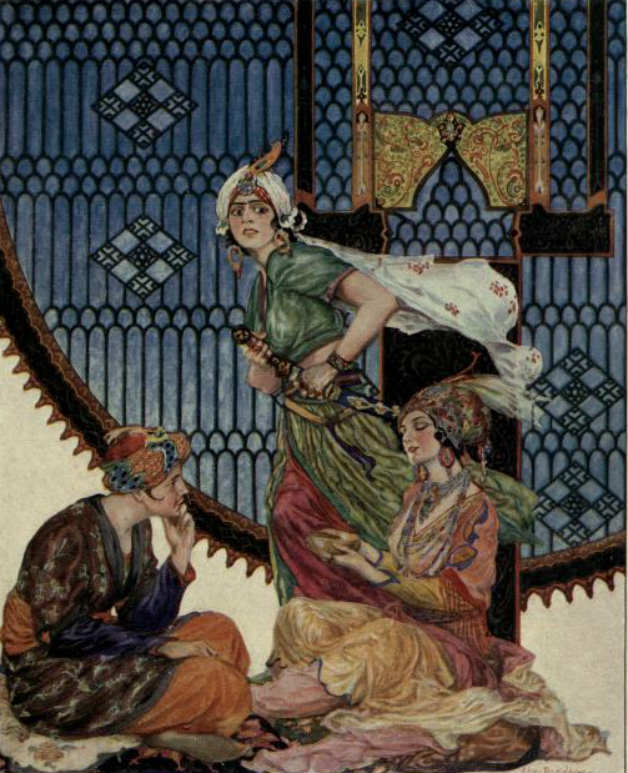
“She wore a magnificent necklace of jewels.” Illustration by Frances Jenkins Olcott from More Tales from the Arabian Nights by Edward William Lane, published 1915.
Some of the most famous Arabic folk tales are contained in One Thousand and One Nights, compiled during the Islamic Golden Age. The most popular edition of this collection of folk tales was published by Andrew Lang in 1898, and he renamed it The Arabian Nights Entertainments. The origins of the stories in this collection are complex. Iraqi influence is seen added to the stories in the 9th or 10th century, and the original few stories can be traced back to India and Persia in the 8th century. They are a rare gem for the literary world, and their roots and reach extend farther than can be measured. Other Arabic fairy tale collections include Folk-Lore and Legends: Oriental, a publication with an unknown author.
Arabic fairy tales were a source of entertainment and not tales for moral lessons and religious custom, unlike their European counterparts. The fairy tales are robust with themes of romance and magic that offered countless evenings of entertainment, and inspired a rich culture of fables, epic poems, historical anecdotes, songs and dance that have circulated the world over.
- The Arabian Nights
- Ameen and the Ghool
- The Adventures of Prince Camaralzaman and the Princess Badoura
- Aladdin and the Wonderful Lamp
- The Adventures of Haroun-al-Raschid, Caliph of Bagdad
- Little Muck
- The Little Hunchback
- The Legend of the Terrestrial Paradise of Sheddád, the Son of 'A'd
- Legend of Dhurrumnath
- The Relations of Ssidi Kur – 11. Of the Maiden Ssuwarandari
- The Relations of Ssidi Kur – 10. The Man and his Wife
- The Relations of Ssidi Kur – 8. The Painter and the Wood-carver
- The Relations of Ssidi Kur – 7. The Bird-man
- The Relations of Ssidi Kur – 6. The Wonderful Man Who Overcame the Chan
- The Relations of Ssidi Kur – 5. The History of Sunshine and His Brother
- The Relations of Ssidi Kur – 4. The Magician with the Swine's Head
- The Relations of Ssidi Kur – 3. The Adventures of Massang
- The Relations of Ssidi Kur - 2. The Adventures of the Beggar's Son
- The Relations of Ssidi Kur - 1. The Adventures of the Rich Youth
- The Relations of Ssidi Kur - Intro
- The Relations of Ssidi Kur – 9. The Stealing of the Heart
- The Story of the Two Sisters Who Were Jealous of Their Younger Sister
- The Story of Ali Cogia, Merchant of Bagdad
- The Story of Sidi-Nouman
- The Story of the Blind Baba-Abdalla
- The Story of the Hewn-Off Hand
- The Story of the False Prince
- The Story of Prince Ahmed and the Fairy Paribanou
- The Story of the Barber's Sixth Brother
- The Story of the Barber's Fifth Brother
- The Seven Voyages of Sindbad the Sailor: The Seventh and Final Voyage
- The Seven Voyages of Sindbad the Sailor: The Fifth Voyage
- The Shepherd and the Jogie
- The Story of the Merchant and the Genius
- The Story of the First Old Man and of the Hind
- The Story of the Second Old Man, and the Two Black Dogs
- The Story of the Fisherman
- The Story of the Greek King and the Physician Douban
- The Story of the Husband and the Parrot
- The Story of the Vizir Who Was Punished
- The Story of the Young King of the Black Isles
- The Story of the Three Calenders, Sons of Kings, and of Five Ladies of Bagdad
- The Story of the First Calender, Son of a King
- The Story of the Second Calender, Son of a King
- The Story of the Envious Man and of Him Who Was Envied
- The Story of the Third Calender, Son of a King
- The Seven Voyages of Sindbad the Sailor
- The Seven Voyages of Sindbad the Sailor: The First Voyage
- The Seven Voyages of Sindbad the Sailor: The Second Voyage
- The Seven Voyages of Sindbad the Sailor: The Third Voyage
- The Seven Voyages of Sindbad the Sailor: The Fourth Voyage
- The Seven Voyages of Sindbad the Sailor: The Sixth Voyage